Oscillio
A configurable bond OEMS that bends to the trader, sitting on top of the venues a desk already uses.
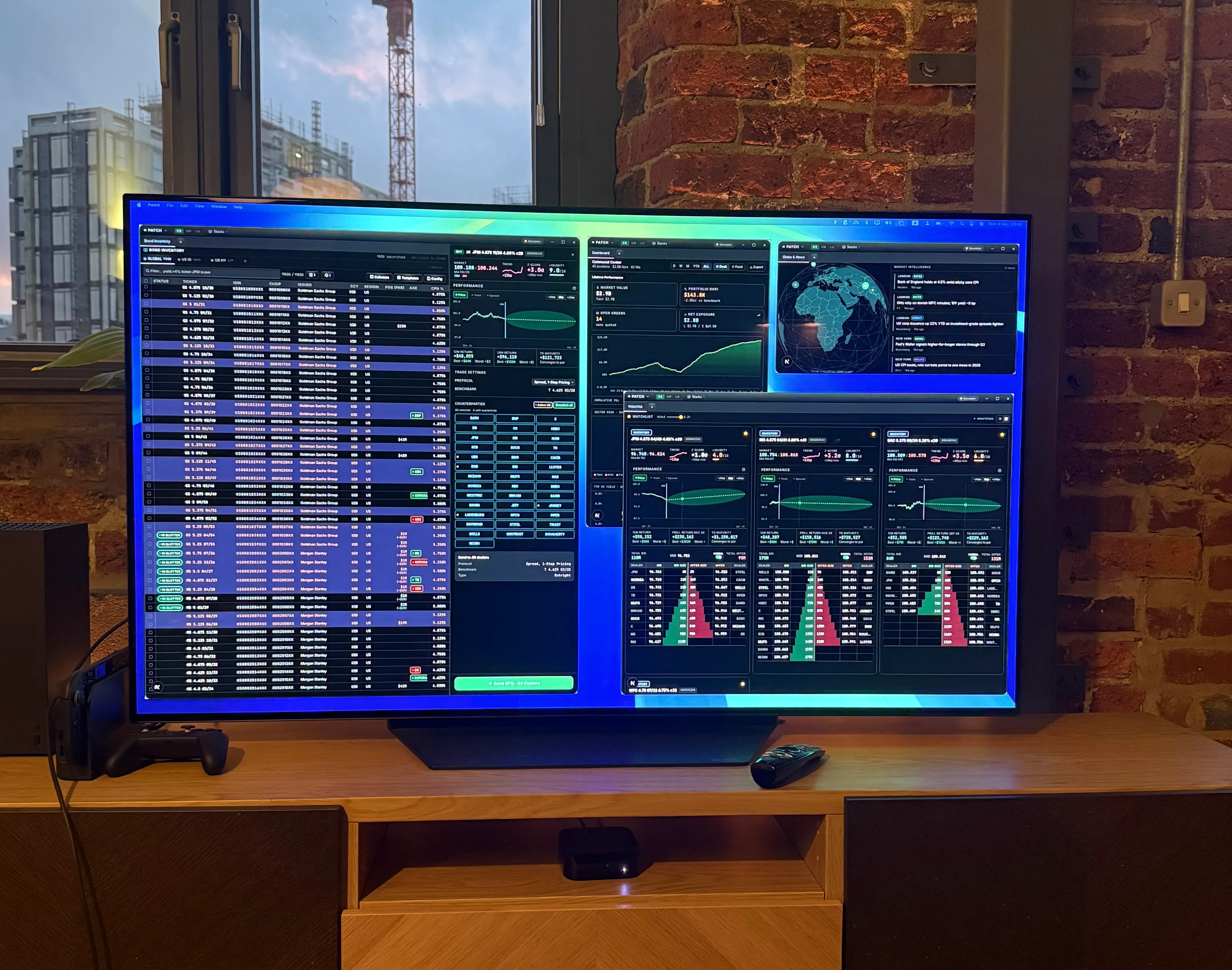
Oscillio is a prototype bond OEMS for buy-side fixed income desks I built with AI. This is a continuation of my exploration of designing with AI, expanding the possibilities of prototyping, with an engine of nearly 10,000 simulated corporate bonds with real-time charting, constantly fluctuating prices and a simulated RFQ environment for executing trades.
An OEMS, shorthand for order & execution management system, is a workspace for traders to manage their orders, make informed decisions, and execute their trades. Oscillio is my interpretation of this workspace, using my years of experience designing for fixed income workflows at MarketAxess, tackling familiar problems head-on using AI prototyping.
It’s important to note that my intention for this project from the start was to treat this as a true end-to-end project, less of a clickable prototype, more of a functioning React-based MVP with Auth0 login, session management, window management and data simulation.
Furthermore, Oscillio is designed to be a complementary layer on top of a trader’s existing relationships with their dealers and their venue of choice - not a replacement. Oscillio simply taps into that existing workflow and provides a better, more cohesive experience for the entire order management and execution journey.
Background
Unlike equities, the corporate bond market has been traditionally slow to adopt new technologies. But in the last decade, new regulations forcing an increase in pre- and post-trade transparency have helped accelerate the adoption of electronic trading, leaving over-the-phone dealings further and further behind. Then in 2020, the COVID-19 pandemic more or less forced most bond sectors online, as remote work became the norm overnight.
In the years since, electronification of the corporate bond market has continued to mature, offering traders powerful tools for automation, algorithmic trading and portfolio trading, growing in favourability among many bond traders.
The problem
Many incumbent platforms are slow to adapt and struggle when it comes to delivering a consistent user experience among different features and workflows. The tools that own this space are indeed powerful - but often rigid in their design and held back by older technology stacks and legacy systems. Furthermore, these tools often do very little to distil complexity for different types of users; it’s very much a what you see is what you get scenario.
Finding a solution
I wanted to design an OEMS built on a lean framework, a modular, fully customisable front-end so the user has better control of their data and how it’s displayed. Whether they’re working from a browser on their laptop, or locked in at their multi-screen desk, Oscillio should perform as expected in a high-stakes environment.
Oscillio is designed for the high-stakes, time-sensitive world of bond trading, ensuring a delicate balance between a trading experience with minimal friction and the necessary guardrails at the right moments. A trader should be able to navigate large lists of bonds with little to no slowdown, while the core trade execution experience is designed with speed bumps to eliminate accidental trades. They should never feel like the UI is struggling to keep pace, but ready to serve at every stage.
The UI should feel snappy and responsive. There’s little room for overly elaborate transitions or micro-interactions in the wrong places. A trader should never feel left in the dark - success states should feel intentional, hitting the trade button should hold weight and feel meaningful. And when things don’t go according to plan, it can be frustrating to receive vague error messages that lack context, or worse - no feedback at all. So it’s crucial that the trader remains informed at every step of the journey.
Familiarity is key. Make it easy for the trader to hit the ground running. Allow them to configure their workspace to their workflow. Embrace tried and tested conventions a trader will be used to, but introduce more widely used patterns that will elevate their experience.
Key features
A flexible approach to displaying analytics. Add / remove analytics blocks, reorder and save views for different baskets.
Intuitive filtering using operators. Create smart lists, notifications and formatting based on set conditions.
Set multiple rules and alerts, full control over styling.
See projected returns based on size of order, yield and bond rating.
Select multiple orders as a basket: fine-tune order quantities based on liquidity, price, spread and yield.
Open a tab in a new window, assemble and save a window layout tailored to your workspace, from laptop to multi-screen desk.
Built with GoldenLayout. Multi-window support, resizable panels, pull panels out into new windows. Full persistence between sessions.
Final thoughts
Introducing Claude Code as part of my process this year has been a game changer that has allowed a far higher level of fidelity that just wasn’t possible for prototyping before. But from a UI perspective, it takes additional effort to steer away from standard cookie-cutter visual styling that has become so commonplace in 2026, without a Figma design for reference.
I wanted to push myself out of my comfort zone and work almost exclusively in code for this project. However, going forward I’ll be embracing the best of both worlds.